Higher Arity Science
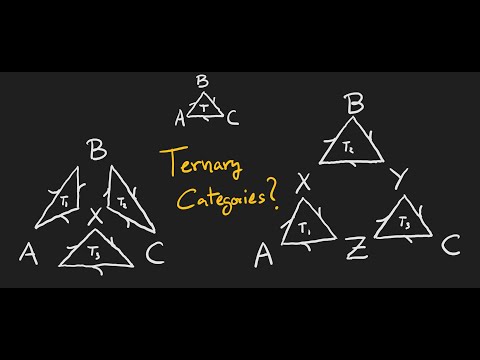
The order of a relation or the number of arguments of a function is called its arity. Most of modern mathematics and science uses arity 2, i.e. binary operations and relations, but there is increasing evidence of the limitations of these tools to describe emergent behaviour in complex systems. The abstract study of arity can be understood as the investigation of the "atoms of emergence".
arity.science →
Generalizations of Associativity in Ternary Structures
Filippov algebras, the n-ary generalization of (binary) Lie algebras, are not well understood as infinitesimal objects of global counterparts, in the same way that Lie algebras are infinitesimal Lie groups. In an attempt to develop some intuition for ternary Filippov algebras, I identified a set of axioms for a ternary operation that generalizes associativity which, curiously, had not been noted in the mathematical literature before. I call this property trisociativity. It turns out that cubic matrices carry natural ternary products that seem to be somewhat related to trisociativity.
Foundations of Phase Space Physics
What are the converging and diverging features of classical, quantum and statistical mechanics? Symplectic and contact geometry seem to be unifying themes. How can we find a complete characterization of observables and dynamics, both quantum and classical, in terms of categories of phase spaces and associated algebraic structures? My PhD thesis contains a review of these topics and some tentative approaches to the categorization of phase space theories.
Unit-Free and Dimensioned Approaches to Jacobi Geometry
In an attempt to integrate physical dimensions and units of measurement into geometric mechanics explicitly, I found a surprisingly transparent interpretation of Jacobi geometry as the unit-free counterpart of Poisson geometry. This led, in turn, to the identification of new algebraic structures that formally generalize the notion of physical dimension. These structures are first introduced in my PhD thesis under the name 'dimensioned structures' and are further studied in my papers on the topic.
Related publications →
Cognitiveness as a Measurable Property of a System
Is the degree to which a system is considered cognitive, its 'cognitiveness', something that can be theoretically parametrised and experimentally measured? Relatively recent advancements in the fields of animal cognition, AI development and ant colony psychology suggest common themes between seemingly dissimilar systems. As a project living at the intersection of cognitive science, complexity science and physics, this will require a long and careful study of the existing literature and the development of formal (mathematical) frameworks that aid in the integration of knowledge from many different branches.
Talk: A Landscape of Cognitiveness →
Foundations of Relativity and Quantum Observers
Classical relativity theory seems to be naturally connected with classical phase spaces, since one may recover Euclidean configuration spaces in the context of the causal structure of Minkowski spacetimes. Is there a direct analogue for quantum phase spaces? In other words, can we find a geometric object where quantum observers can be axiomatized, the principle of relativity implemented, and that naturally contains projective Hilbert spaces (quantum phase spaces)? This may lead to a notion of 'quantum relativity' that is entirely unrelated to 'quantum gravity' but may, nonetheless, shed some light on the conundrum posed by the latter.
Deep Themes in Mathematics and Physics (with Michael Atiyah)
During the years of my PhD in Edinburgh I was fortunate to work as Michael Atiyah's personal research assistant, accompanying him during his last few years. The passion and drive for mathematics, science and beauty was very much still there. In the many long conversations I shared with Michael, touching on the deep connections between algebra, geometry and physics, I could glimpse a mind that once had one of the most comprehensive vantage points of modern mathematics. A small collaboration on the application of K-theory to knots followed from these conversations.
K-Theory and the Jones Polynomial →
Verbal Cognition vs Visual Cognition
Most intellectual work is encapsulated in symbolic languages, typically verbal ones, i.e. the written word. This contrasts with how we seem to comprehend shape and spatial structure instinctively and to a high degree of sophistication without any use of verbal language. I am developing a comparative cognitive study, to be conducted with human subjects, that will test the suitability of verbal language for the efficient description of shape.